Students/Staff
 Parents
 ElevatEd
A multiplication chart 1 to 12 is a grid where the row number and the column number meet at their product. Common Core expects children to know every product of two one-digit numbers from memory by the end of Grade 3. That covers the chart up to 9 × 9. The 10, 11 and 12 rows sit outside the standard.
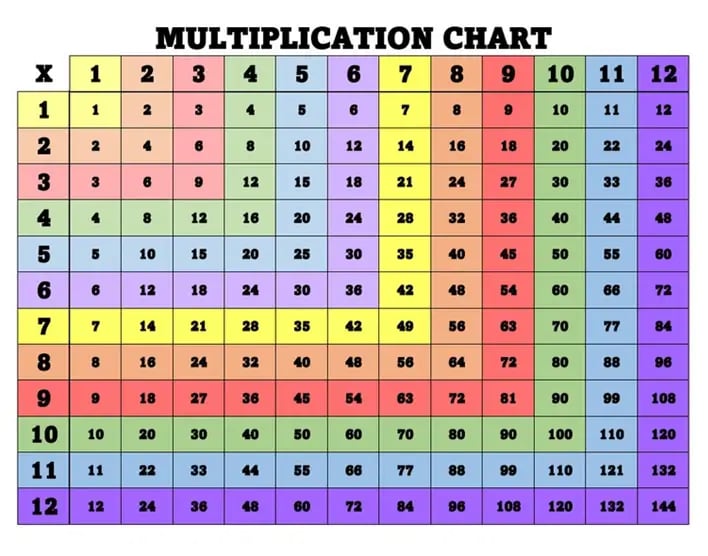
Print the image above, or use the table below, which you can copy straight into a document. Underneath both, there is the part most charts leave out: which facts your child actually has to learn, and how few of them there really are.
Book FREE Math Trial Classes Now!
The multiplication chart 1 to 12
Find your first number in the left hand column, your second number along the top row, and read across and down to where they meet. For 7 × 8, start at 7 on the left, move right to the column headed 8, and the answer is 56.
| × | 1 | 2 | 3 | 4 | 5 | 6 | 7 | 8 | 9 | 10 | 11 | 12 |
|---|---|---|---|---|---|---|---|---|---|---|---|---|
| 1 | 1 | 2 | 3 | 4 | 5 | 6 | 7 | 8 | 9 | 10 | 11 | 12 |
| 2 | 2 | 4 | 6 | 8 | 10 | 12 | 14 | 16 | 18 | 20 | 22 | 24 |
| 3 | 3 | 6 | 9 | 12 | 15 | 18 | 21 | 24 | 27 | 30 | 33 | 36 |
| 4 | 4 | 8 | 12 | 16 | 20 | 24 | 28 | 32 | 36 | 40 | 44 | 48 |
| 5 | 5 | 10 | 15 | 20 | 25 | 30 | 35 | 40 | 45 | 50 | 55 | 60 |
| 6 | 6 | 12 | 18 | 24 | 30 | 36 | 42 | 48 | 54 | 60 | 66 | 72 |
| 7 | 7 | 14 | 21 | 28 | 35 | 42 | 49 | 56 | 63 | 70 | 77 | 84 |
| 8 | 8 | 16 | 24 | 32 | 40 | 48 | 56 | 64 | 72 | 80 | 88 | 96 |
| 9 | 9 | 18 | 27 | 36 | 45 | 54 | 63 | 72 | 81 | 90 | 99 | 108 |
| 10 | 10 | 20 | 30 | 40 | 50 | 60 | 70 | 80 | 90 | 100 | 110 | 120 |
| 11 | 11 | 22 | 33 | 44 | 55 | 66 | 77 | 88 | 99 | 110 | 121 | 132 |
| 12 | 12 | 24 | 36 | 48 | 60 | 72 | 84 | 96 | 108 | 120 | 132 | 144 |
What grade should my child know the multiplication chart by?
The US standard is specific. Common Core standard 3.OA.C.7 asks that by the end of Grade 3 a child knows from memory all products of two one-digit numbers. That is everything up to 9 × 9.
The 10, 11 and 12 rows sit outside that standard. No Common Core standard asks for them, so when they are taught varies by school and by curriculum. The 10 row is the least work of the three, because multiplying by 10 adds a zero.
The practical point for a parent: a Grade 3 child who is solid to 9 × 9 is exactly where the standard expects them to be, even if the wall chart goes to 12.
If your child is in Grade 4 or above and still counting up to reach 7 × 8, the gap is recall speed rather than understanding. That is a practice problem, and it is a smaller one than it looks. The next section explains why.
How many multiplication facts are there really?
The chart shows 144 cells, which is what makes it look like a mountain. The number of facts a child actually has to learn is 36.
Three things collapse the number:
- Order does not change the answer. 7 × 8 and 8 × 7 are the same fact learned once. That takes 144 cells down to 78.
- The 1 and 10 rows are patterns, not facts. Anything times 1 is itself. Anything times 10 adds a zero. Neither needs memorizing.
- The 2 and 5 rows come almost free. Doubling and counting in fives are usually secure long before the times tables start.
Take out the 1, 2, 5 and 10 rows and 78 becomes 36. Eight of those are squares, which children often find easier because both numbers are the same: 3×3, 4×4, 6×6, 7×7, 8×8, 9×9, 11×11, 12×12.
That leaves 28 genuinely new facts. At three or four a week, that is a term, not a mountain. It is worth showing your child this count, because the chart's 144 cells are the reason many of them decide the task is impossible before starting.
How do we practice the times tables at home?
Ten minutes a day beats an hour at the weekend, and the aim is recall speed rather than working it out. A child who can reach the right answer by counting up has understood multiplication. They have not finished learning the fact.
- Work one row at a time. Pick a row, stay on it for a few days, and only add the next when the first is quick. Jumping around the chart is how children end up half knowing all of it.
- Say it out loud. Reading a chart and recalling a fact are different skills. Cover the chart and ask.
- Use the commutative pair. When your child learns 7 × 8, point out they have just learned 8 × 7 as well. It halves the work and it is the single most useful thing to tell them. There is more on this in our note on what a multiplication chart shows.
- Look for the patterns. Up to 9 × 10, the two digits of every answer in the 9 row add to 9: 18, 27, 36, 45. The 5 row ends in 5 or 0. Patterns give a child a way back when recall fails.
- Keep a miss list. Write down only the facts they got wrong and re-test those. Most children find the list is far shorter than they feared.
- Put the chart somewhere ordinary. The fridge, the back of a bedroom door. Glancing at it fifty times a week does more than one long session.
- Make it a game where you can. Multiplication card games and board games work because they remove the sense of being tested. Our faster ways to use a multiplication chart covers a few.
If you want printable practice between sessions, there are free Math worksheets to work from.
What comes after the 1 to 12 chart?
Once the 12 × 12 grid is secure, the chart stops being the thing to practice and starts being a tool. It is what a child reaches for when working on division, fractions, factors and multiples. Common Core standard 4.OA.B.4 asks Grade 4 children to find all factor pairs for numbers up to 100 and to tell prime from composite, and a child who has to work out 7 × 8 each time will find that slow going.
Some children go on to a 1 to 20 chart, and there are tips for working with the larger grid. It is worth saying that this is enrichment rather than a requirement. No US grade standard asks for it, and a child who knows 1 to 12 cold is better served by moving on to division than by extending the grid.
Questions parents ask
What is a multiplication chart?
A multiplication chart, also called a times table, is a grid showing the product of two numbers. Consecutive numbers run along the top and down the left side, and each cell holds the result of multiplying its row number by its column number. You find any product by tracing across from one number and down from the other to where they meet.
What grade do children learn the multiplication chart?
Common Core asks children to know all products of two one-digit numbers from memory by the end of Grade 3, which covers the chart up to 9 times 9. The 10, 11 and 12 rows are not named in any Common Core standard, so when a school teaches them varies. A Grade 3 child secure to 9 times 9 is where the standard expects them to be.
Does the order of the numbers matter in multiplication?
No. Multiplying 3 by 4 and 4 by 3 both give 12. This is called the commutative property, and it is the most useful thing a child can know about the chart, because it means 144 cells contain only 78 different facts. Every fact learned one way round is learned both ways.
How long does it take to learn the times tables?
Once you remove the 1, 2, 5 and 10 rows and count each fact only once, there are 36 facts left. At three or four new facts a week with short daily practice, that is roughly a school term. Children who already know their doubles usually move faster than that.
Should my child use a chart or memorize the facts?
Both, in that order. The chart is how a child sees the patterns and checks their own work. Recall is what they need for division and fractions later, where stopping to look up a product interrupts the actual problem. Use the chart while learning, then cover it and practice recalling.
When was the multiplication table invented?
Babylonian clay tablets from around 2000 BC carry multiplication tables, though written in base 60 rather than the base 10 we use. The oldest known decimal multiplication table is a set of bamboo strips from China dated to roughly 305 BC, held by Tsinghua University.
The chart itself is the easy part. The work is turning 36 facts into instant recall, and that is a few minutes a day over a term rather than anything dramatic. If you would rather have a teacher working through it with your child each week, that is what our Grade 1 to 8 Math classes are built for. You can also compare the times table formats if you are deciding which chart to print.
Book FREE Math Trial Classes Now!
Related Articles
1. Multiplication and Division of Decimals
2. Difference Addition and Subtraction of Decimals
3. How Does Early Math Revision Improve Academic Performance?
4. Multiplying and Dividing Negative Numbers